A replacement power cable for a stage light or AV rack needs more than a plug that looks familiar. The connector must match the equipment outlet, accept the selected cable and suit the electrical requirements of the complete assembly.
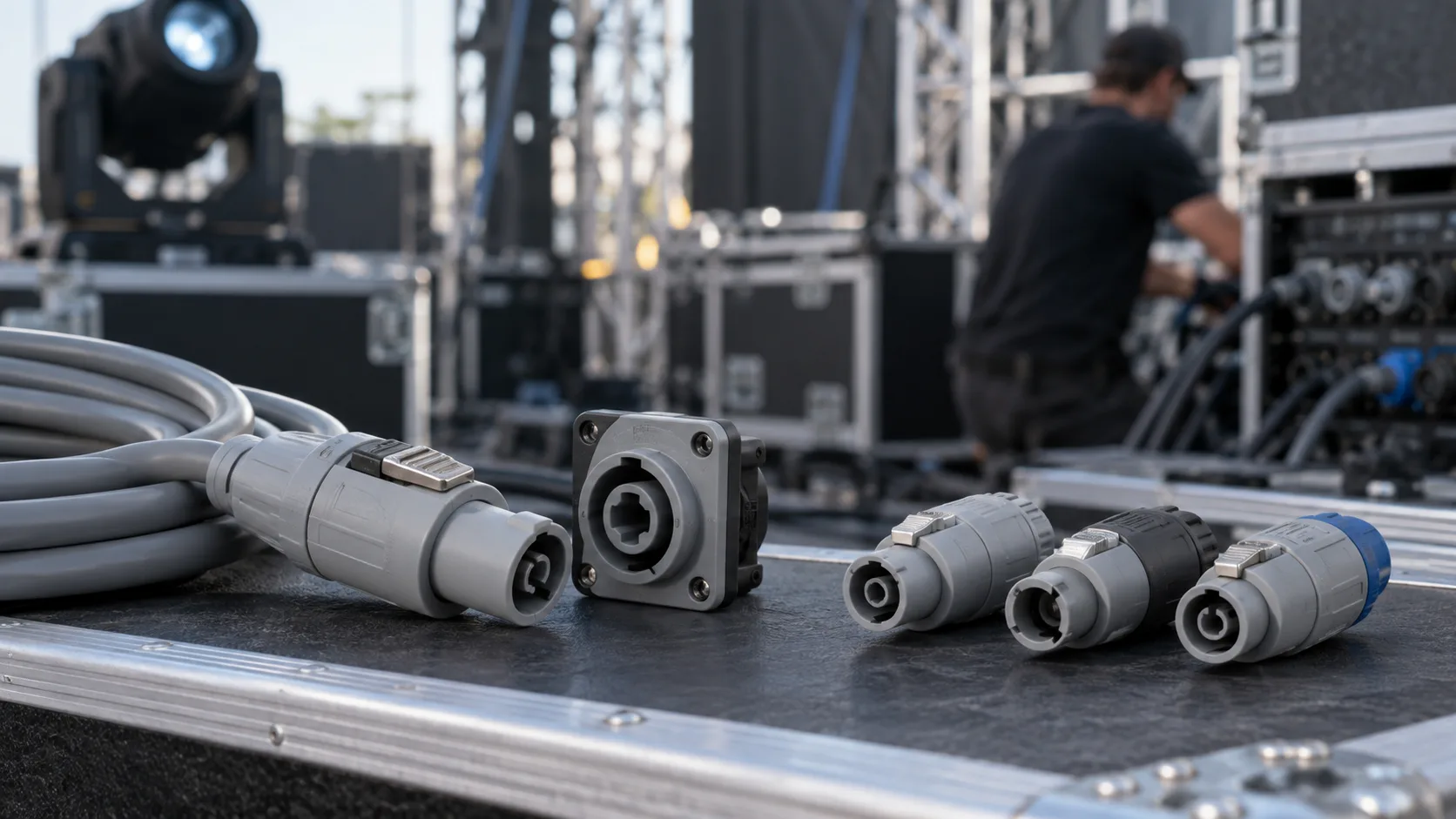
A grey PowerCON cable connector is commonly associated with the power-out side of equipment. Understanding that role helps when specifying interconnection leads for lighting fixtures, portable AV systems and equipment racks. This guide explains the main selection questions and shows where the HPB-05GY fits into the process.
What Does a Grey PowerCON Connector Do?
In the traditional blue/grey powerCON system, blue identifies power-in and grey identifies power-out. The two versions use different mechanical keying to prevent incorrect mating. Neutrik describes this distinction in its powerCON technical FAQ.
Think of “in” and “out” from the equipment’s perspective. A power-out cable connector mates with the corresponding equipment outlet to take power onward through a cable. It is not a universal plug for any inlet that happens to have a similar outline.
When ordering from any supplier, specify the model and intended mating component as well as the color. A grey housing alone does not establish compatibility across manufacturers or connector families.
Blue vs Grey: Which End Belongs Where?
For equipment designed to provide a compatible power-link output, a typical interconnection lead runs from one unit’s power-out socket to the next unit’s power-in socket. Both ends must match their respective equipment connections.
| Selection detail | Power-in side | Power-out side |
|---|---|---|
| Traditional blue/grey identification | Blue | Grey |
| Role at the equipment | Receives the incoming supply | Provides an outgoing connection where the equipment supports it |
| What to specify | The exact inlet and matching cable connector | The exact outlet and matching cable connector |
The equipment manual determines whether linking is supported and what limits apply. Do not infer a permitted connection from the presence of a socket alone. Label interconnection leads so technicians can identify their intended use during setup and when returning them to storage.
Where the HPB-05GY Fits
For projects requiring a grey power-out cable termination, the HPB-05GY PowerCON 3 Pin Female Cable Connector is a model to evaluate. Chengyu Tech lists it as a cable-mounted connector with a twist-lock interface and an insulated housing, intended for professional audio, stage lighting and equipment interconnections.
Its product page identifies three contacts for L, N and PE and lists 20A / 250V among the key features. OEM/ODM customization is also available. These details make the model relevant to a cable assembly specification, but the final choice should also account for the mating outlet, cable dimensions and documented operating conditions.
Ask for the current datasheet and a matching-component reference before approving a sample. This is especially useful when replacing an existing cable end, where the original connector may belong to a different series.
Five Details to Confirm Before Ordering
1. Exact mating compatibility
Record the manufacturer and part number on the equipment outlet. Request confirmation that the proposed cable connector is intended to mate with it. Check the drawing and sample fit rather than treating a product name or a similar locking shape as proof.
If several types of power connector are used across your inventory, keep approved pairings in the purchasing specification. This reduces the chance of a substitute part reaching a technician who expects a direct replacement.
2. Cable diameter and conductor capacity
The cable jacket must fit the connector’s cable entry and strain relief, while the conductors must fit its terminals. These are separate requirements. A cable can have suitable conductors yet still be too small or too large for the connector’s retention system.
Request the supported outer diameter range, conductor size range, assembly instructions and tightening requirements for the HPB-05GY. Have mains cable assemblies built and tested by qualified personnel using the specified components and instructions.
3. Ratings for the complete connection
A connector’s current rating does not automatically become the allowable current for an entire lead or equipment chain. The cable, mating socket, equipment pass-through circuit and upstream protection each impose their own limits.
For procurement, record the conditions attached to the rating and request any certification documentation required by the project. A product description is not a substitute for a certificate covering the exact part and intended application.
4. Connection and disconnection conditions
A twist-lock mechanism provides retention; it does not by itself establish permission to connect or disconnect while energized. Neutrik’s original NAC3FCA product documentation, for example, specifies that this model has no breaking capacity and must not be connected or disconnected live or under load. That statement concerns the named Neutrik model, not a verified specification for HPB-05GY.
The HPB-05GY page does not state a breaking-capacity rating. Do not assume live-mating capability. Isolate the supply before connecting or disconnecting it, and obtain the supplier’s operating instructions for the proposed assembly.
5. Environmental requirements
A stage application may involve indoor use, sheltered outdoor use or exposure to rain and dust. These are different design conditions. An insulated housing and a locking mechanism do not establish an ingress-protection rating.
If the project requires weather protection, request a documented rating for the complete mated connection and any required accessories. The HPB-05GY product page does not establish a waterproof rating.
How Many Stage Lights Can Be Linked Together?
There is no universal fixture count based only on the connector. Start with the lighting manufacturer’s maximum linking allowance, then evaluate the total downstream load against the output, cable and supply limits.
The first link can carry the combined demand of several downstream units, so its load may be higher than the consumption of a single fixture. Use the equipment’s input-current information and account for the manufacturer’s startup or inrush requirements. Avoid choosing a chain length simply by dividing a connector rating by an advertised lamp wattage.
For a rental inventory, document the permitted fixture combinations and cable assemblies. A clear equipment-specific limit is more useful during setup than an unsupported “maximum number of lights” printed on a generic cable label.
Sample Checks for Cable Assemblers and AV Buyers
Before placing a bulk order, evaluate the connector with the intended equipment outlet and cable. Include the following points in the sample review:
- The approved plug and outlet pair mates and locks as intended.
- The release mechanism remains accessible in the actual equipment layout.
- The cable entry and strain relief match the selected cable jacket.
- The assembly instructions specify the terminal preparation and tightening requirements.
- Qualified personnel complete the applicable continuity, protective-earth and insulation checks before service.
- The finished lead has clear identification and traceable component details.
For a project considering this model, send the supplier the outlet part number, cable specification, intended operating conditions and order quantity alongside the HPB-05GY product reference. That gives the supplier the information needed to confirm suitability or recommend a different configuration.
Frequently Asked Questions
What do the three contacts on HPB-05GY represent?
The product page identifies L, N and PE: line, neutral and protective earth. Use the exact terminal markings and manufacturer’s assembly instructions; this is not an audio signal connector.
Can I use a grey connector in a blue power inlet?
The traditional blue and grey versions have different keying and roles. Specify the correct mating pair instead of trying to interchange them.
Is HPB-05GY interchangeable with every PowerCON connector?
Do not assume universal interchangeability. Confirm the exact mating model, mechanical interface and ratings with the supplier before using it as a replacement.
Does the listed 20A rating mean every assembled cable can carry 20A?
No. The permissible load also depends on the cable, mating component, equipment, installation conditions and applicable requirements. Evaluate the complete assembly.
Is the HPB-05GY suitable for outdoor stage lighting?
That requires an environmental assessment and documented protection appropriate to the application. The product page’s stage-lighting application statement does not establish suitability for exposure to rain.